
Solar and Battery Heating: Electric Heaters for Off-Peak and Off-Grid Homes
Heat from a battery, charged cheaply or for free.
More UK homes now have a battery, solar panels or a smart tariff, often all three. Store cheap or free electricity, then let your heaters draw on it when grid power is at its most expensive. This guide explains how it works, what it really saves, and why electric panel heaters suit it so well. Our advice runs right through it: WiFi heaters for control, and the SolAire EXO ceramic core radiator for heat retention.
*Prices as at 15 October 2026. Sources and assumptions are listed at the end of this guide.
Capture, store, then heat.
A home battery separates the moment you buy or make electricity from the moment you use it. Whether you fill it overnight on a cheap tariff or from solar panels during the day, your heaters use the same stored energy.
Capture it cheaply.
The battery charges when electricity costs least: overnight on an off-peak tariff, or for nothing when your solar panels or wind turbine produce more than the house is using.
Store it.
A typical home battery holds 5 to 13.5 kWh of usable energy. A little is lost in storage, about 10 percent on a round trip, so we allow for that in every sum in this guide.
Heat from it.
During the day and evening, when grid prices are highest, your heaters run from the battery. The thermostat and timer decide when each room needs heat, and the battery pays for it.
There are two ways to fill the battery, and most homes end up using both. Section 02 covers cheap off-peak grid electricity, which works all year round. Section 03 covers free renewable energy from solar or wind, which is plentiful for much of the year but weaker in the depths of winter.
Two heaters do most of the work.
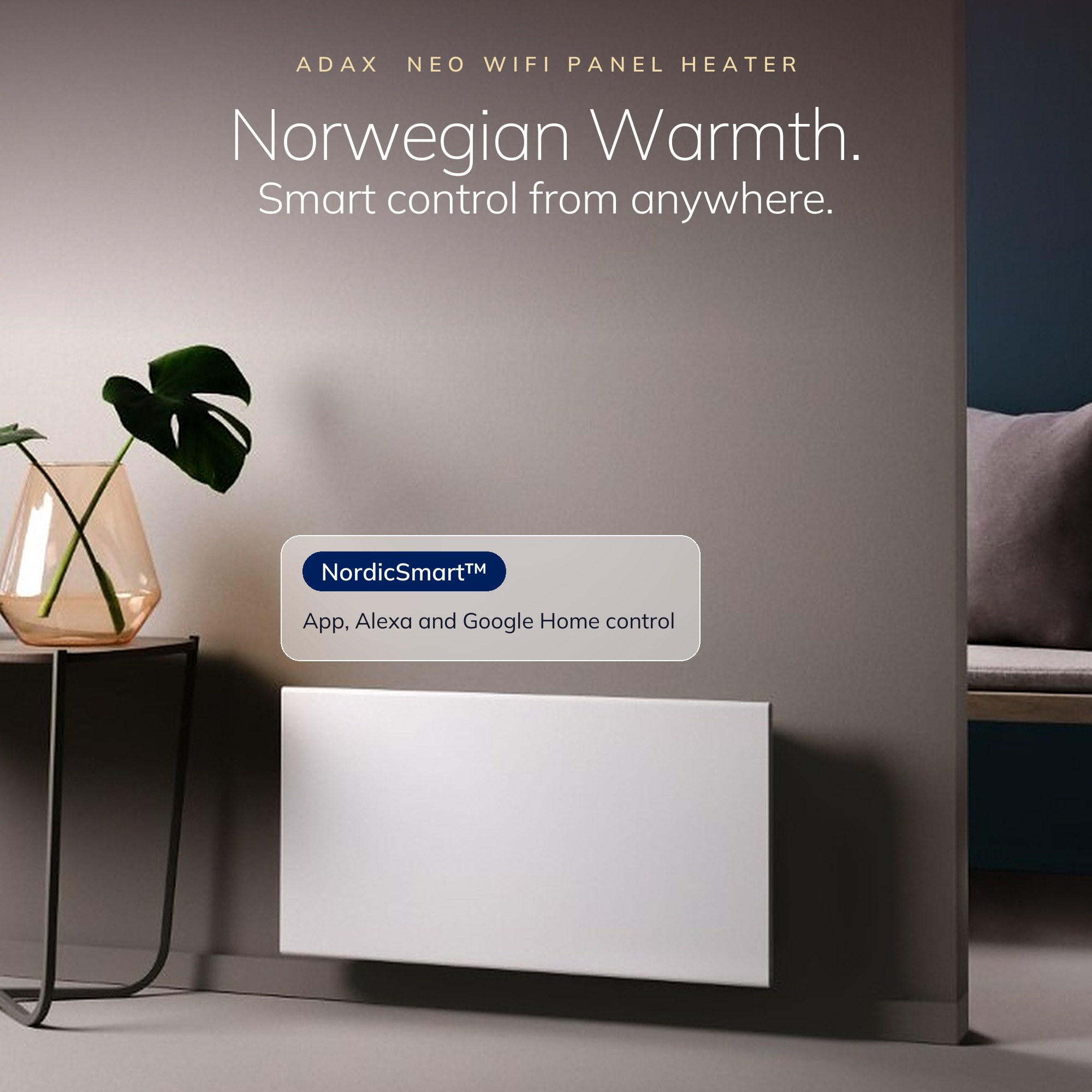
For control, choose a WiFi heater such as the ADAX Neo WiFi, SolAire Lyndo WiFi or SolAire Caldo WiFi: you can set schedules around your battery and tariff from your phone and change them in seconds. For heat retention, put the SolAire EXO ceramic core radiator in the rooms you use most: its ceramic core keeps giving off warmth after it switches off, so the heat you paid for cheaply lasts longer. Browse every WiFi panel heater in the range.
Buy it at night, use it all day.
Smart tariffs charge far less for electricity in a fixed overnight window. With a battery, you no longer have to be awake or using power at that hour to benefit: the battery fills up overnight and the house runs on that cheap electricity the next day.
Off-peak tariffs compared
| Tariff | Cheap window | Cheap rate | Day rate | Who can join |
|---|---|---|---|---|
| Intelligent Octopus Go | 23:30 to 05:30 | 7.60p | 36.70p | Needs a compatible electric car or smart EV charger |
| Octopus Go | 00:30 to 05:30 | 9.50p | 35.30p | Needs an electric car charged at home |
| Octopus Flux | 02:00 to 05:00 | 14.43p | 24.04p, rising to 33.66p from 16:00 to 19:00 | Needs solar panels and an export meter registration |
| Economy 7 (Flexible Octopus) | 7 hours overnight, set by your meter | 14.19p | 32.65p | Any home with a two-rate meter |
| Ofgem price cap, single rate | None | 26.32p at all times | Reference point for standard variable tariffs | |
Unit rates in pence per kWh as at 15 October 2026, paying by Direct Debit, averaged across all 14 GB electricity regions. Octopus Go and Intelligent Octopus Go figures are the 12 month fixed versions, which are the only versions Octopus is currently offering new customers; both carry a £50 exit fee. Your regional rate will differ by a penny or two either way. There is no VAT on electricity from 1 October 2026 to 31 March 2027.
Read the “who can join” column carefully. The cheapest overnight rates are EV tariffs. If you have a battery but no electric car, Economy 7, Octopus Flux (if you also have solar) or a half-hourly tariff such as Agile Octopus are the realistic options.
What it saves: a worked example
Take a 1000W living room heater, a 600W home office heater and a 400W hallway heater, used for 6 hours a day. With thermostats cycling, they draw about half their rated power on average, so they use around 6 kWh of electricity a day. Allowing for a 10 percent battery loss, you need to put 6.67 kWh into the battery overnight to get 6 kWh back out.
| Tariff | 6 kWh from the battery, charged off-peak | Same 6 kWh bought at the day rate | Saving per day | Over a 150 day heating season |
|---|---|---|---|---|
| Intelligent Octopus Go | £0.51 | £2.20 | £1.70 | £254 |
| Octopus Go | £0.63 | £2.12 | £1.48 | £223 |
| Economy 7 | £0.95 | £1.96 | £1.01 | £152 |
| Octopus Flux | £0.96 | £1.44 | £0.48 | £72 |
Example figures use the national average rates above, a 90 percent battery round trip efficiency and a 50 percent thermostat duty cycle. Flux is compared against its standard daytime rate; heaters used during its 16:00 to 19:00 peak save more. Savings are for these three heaters only and exclude standing charges, which you pay on any tariff.
Compared with simply staying on the price cap, the same heaters running on battery power charged at Intelligent Octopus Go rates save £1.07 a day. Two things decide your real figure: how much heat your home needs, which our running costs guide walks through, and whether the battery is big enough to cover the whole day, which section 04 covers.
For off-peak charging: schedule with WiFi, bank heat with EXO.
Off-peak windows are fixed by the tariff, and they change when you switch supplier or the clocks change. A WiFi heater lets you move every heater’s schedule from the app instead of reprogramming each one on the wall. The EXO ceramic core radiator adds a trick a battery cannot: run it in the last hour of the cheap window and its core stores warmth into the morning, so the battery has less to do. Fixed schedules work well too, and every heater in our timer and thermostat range has one built in.
Free energy, stored for when you need it.
Solar panels produce most at midday, when many homes are empty or using little power. Heating demand peaks in the morning and evening. A battery bridges that gap: it soaks up the surplus and gives it back at teatime, instead of exporting it to the grid for a few pence.
Free electricity is the cheapest heat there is, but it pays to be realistic about the British winter. A typical 4kWp south facing array in the Midlands averages around 15 kWh a day in June but only 4.3 kWh a day in December, according to the European Commission’s PVGIS solar model. Much of that winter output goes on lights, the fridge and cooking before any heater sees it.
Where solar shines for heating is the shoulder seasons. October averages 8.1 kWh a day and March 10.8 kWh, which is enough to cover a good share of the heating in a well insulated home on a mild day. In midwinter, solar does a smaller share and an off-peak top up does the rest. That is exactly what Octopus Flux is designed for: it pairs cheap overnight charging with solar.
What a 4kWp solar array produces through the heating season
| Month | Oct | Nov | Dec | Jan | Feb | Mar | Apr |
|---|---|---|---|---|---|---|---|
| Average kWh per day | 8.1 | 5.7 | 4.3 | 4.8 | 7.4 | 10.8 | 14.4 |
PVGIS v5.3 estimate for 4kWp in Birmingham, 35 degree south facing roof, 14 percent system losses, using 2005 to 2023 weather data. North of England and Scotland will be lower, the south coast higher.
Wind and other free sources
Small wind turbines complement solar because they tend to produce more in winter, when solar is weakest. They need an exposed site with a strong, steady wind, so they suit rural and coastal properties far better than towns. Whatever the source, the rule is the same: anything that charges the battery for free reduces how much you buy, and your heaters cannot tell the difference.
For solar: soak up the surplus.
Solar surplus arrives at midday, often when nobody is in the room. The SolAire EXO is our pick here: warm it while the panels are exporting and its ceramic core carries that free heat into the afternoon. Pair it with the ADAX Neo WiFi and a home energy platform such as Home Assistant, and heaters can switch on automatically when you are exporting rather than selling the power back for a few pence. Our smart heating controls guide explains the options.
Match the heaters to the battery.
Two numbers matter: how much energy the battery stores, and how much power its inverter can deliver at once. Most disappointing installs get one of them wrong.
Work out your daily heating energy
Add up the wattage of the heaters you use, multiply by the hours they run, then by about 0.5 to allow for the thermostat cycling. Three heaters totalling 2000W for 6 hours comes to about 6 kWh a day. Our what size heater guide helps you pick the right wattage for each room first.
Leave room for the rest of the house
A typical UK home uses around 7 to 8 kWh of electricity a day before any heating. A 10 kWh usable battery would cover the 6 kWh heating example with a little left for the house; to cover everything from cheap electricity, a larger battery or a second unit is needed.
Respect the inverter limit
Many UK home batteries use a 3.6kW or 5kW inverter. Every heater warming up from cold at once, plus a kettle, can exceed that, and the shortfall is simply drawn from the grid at the full rate. Stagger heater start times by 15 to 30 minutes using their timers so the morning warm up stays inside the limit. On a smaller inverter, several 400W, 600W or 800W heaters spread around the house often work better than one 2000W heater.
Allow for battery losses
Charging and discharging loses roughly 10 percent. It is why 6 kWh of heat needs 6.67 kWh of charge, and why the effective cost of Intelligent Octopus Go electricity through a battery is about 8.4p per kWh rather than 7.6p. Still a fraction of the day rate.
Size with WiFi in mind.
With a WiFi heater you can see how each room behaves and adjust its schedule from the app until the whole house fits inside your battery and inverter. Most rooms need around 80W per square metre, so a typical 12 square metre bedroom is well served by a 1000W heater. Start with our what size heater guide, then choose from the WiFi range.
What makes a heater battery friendly.
Every unit of stored energy has cost you something to capture, so the heater on the other end should waste none of it and be easy on the inverter. This is where well designed electric panel heaters come into their own.
Every stored watt becomes heat
At the point of use, an electric panel heater turns 100 percent of the electricity it draws into heat in the room. Nothing goes up a flue and there is no boiler or pipework losing heat on the way.
A gentle, predictable load
A panel heater is a simple resistive load: no motor or compressor to start, so no surge when it switches on, and it draws a steady, known wattage. That makes it easy for a battery inverter to supply, and easy to plan around.
Precise thermostats protect your stored energy
The digital thermostat in the ADAX Neo holds the room at the temperature you set rather than overshooting it, so energy is not wasted heating a room past comfort. The Neo NP is Good Housekeeping Institute Approved for 2026, and it switches silently, with no relay click.
Timers that match your battery window
A 7 day programmable timer, built into the non-WiFi Neo, lets you heat rooms only when they are used and stagger start times to stay inside the inverter limit. Frost protection on every Neo keeps an empty property safe for very little energy.
Smart control that can follow the battery
The ADAX Neo WiFi connects directly to Home Assistant, Tibber, Homey, Google Home and Amazon Alexa, with an open API for anything else; see all our heaters with voice control. In Home Assistant, for example, a heater can be set to come on when solar is exporting or the battery is full, and turn down when the battery runs low. Read more in our guide to ADAX WiFi thermostats.
Small wattages for small systems
The ADAX Neo starts at 400W, so even a modest battery and inverter can heat several rooms at once. Correctly sized heaters running steadily make better use of a battery than one oversized heater. For hallways and under windows, the ADAX Neo WiFi Low Profile fits where a standard panel will not.
Heaters that hold warmth
The Celsius WiFi oil filled radiator and the SolAire EXO ceramic core radiator keep giving off heat after they switch off. Warm them while solar is plentiful, or before the battery runs low, and the room stays comfortable for longer afterwards. If you want one heater built around storing heat, make it the EXO.
The right heater for a battery setup.
| Heater | Wattages | Controls | Best for |
|---|---|---|---|
| SolAire EXO ceramic core Our pick for heat retention | 500W to 2000W | WiFi app, thermostat, timer | Storing cheap or free heat in a ceramic core that keeps radiating after switch off |
| ADAX Neo WiFi Our pick for control | 500W to 2400W | WiFi app, Home Assistant, open API | Automations that follow battery charge or solar export. IP24 rated for bathrooms |
| ADAX Neo | 400W to 2000W | Digital thermostat, 7 day timer | Simple fixed schedules matched to the battery window |
| SolAire Lyndo WiFi | 500W to 2500W | WiFi app, thermostat, timer | Whole home systems on a budget |
| SolAire Caldo WiFi | 500W to 2000W | WiFi app, thermostat, timer | Slimline wall or freestanding use |
| Vitra Verde WiFi | By size | WiFi app, thermostat, timer | Energy efficient, Lot 20 compliant everyday heating |
| Vitra WiFi | By size | WiFi app, thermostat, timer | An affordable way into app scheduled heating |
| Celsius WiFi oil filled | 1000W | WiFi app, timer | Gentle, long lasting warmth in a single room |
| ADAX Comfort towel rail | By size | Thermostat, timer, Musa eco controller | Bathrooms heated in short, timed bursts |
| ADAX Wave towel rail | By size | Thermostat, timer, Musa eco controller | Bathrooms, with a curved design |
Not sure which suits your system? Call us on 01325 717 899 with your battery size, inverter rating and the rooms you want to heat, and we will help you put a plan together. Or browse by type: WiFi panel heaters, heaters with built in timers, all slimline panel heaters, radiant and infrared heaters, WiFi towel rails and towel rails with thermostat and timer.
Garden offices, cabins and holiday lets.
For a building with no grid connection at all, the battery is the only source of power, so efficiency and control matter even more.
Heat the building, not just the room
Insulation decides everything off-grid. A well insulated garden office of 10 square metres can be comfortable on 600W to 800W of heating; an uninsulated shed will drain any battery. A plug in portable heater suits a space you only use occasionally; our portable heaters guide compares them.
Use a pure sine wave inverter
Choose an inverter rated comfortably above the total heater wattage, with a pure sine wave output to suit the electronic thermostats in modern heaters.
Keep frost protection on
In an unoccupied cabin or holiday let, frost protection mode keeps the building above freezing for a fraction of the energy of normal heating, protecting pipes and contents between visits. A WiFi heater such as the ADAX Neo WiFi lets you check the building and warm it up before you arrive, from anywhere.
Plan a backup
A run of grey winter days can empty a solar battery. A small generator or occasional grid charge covers the gap without oversizing the whole system.
Bathrooms and wet rooms
Use splash proof heaters or a towel rail on a timer such as the ADAX Comfort. Our bathroom heating guide covers IP zones, and the space saving range suits small bathrooms and hallways.
Use a qualified installer
Batteries, inverters and fixed heaters should be installed and connected by a qualified electrician to BS 7671, with notifiable work covered by Part P.
Solar and battery heating, answered.
Can I run electric heaters from a home battery?
Yes. Electric panel heaters are among the simplest loads a home battery can supply: a steady, known wattage with no start-up surge. Check that the total wattage of heaters running at once stays within your inverter’s rating, and stagger start times if needed. A WiFi heater makes that easy to manage from your phone.
How big a battery do I need to run my heaters?
Add up heater wattage, multiply by hours of use and then by about 0.5 for thermostat cycling. Three heaters totalling 2000W for 6 hours need about 6 kWh a day, or 6.67 kWh of charge allowing for battery losses. Add the rest of your household use on top.
Will solar panels heat my home in winter?
Partly. A 4kWp array in the Midlands averages about 4.3 kWh a day in December against 15 kWh in June, according to PVGIS. Solar covers a useful share in October, November, February and March; in midwinter most homes top the battery up from a cheap overnight tariff. The SolAire EXO makes the most of short winter surpluses by storing the heat in its ceramic core.
Which tariff should I use with a battery if I do not have an electric car?
Intelligent Octopus Go and Octopus Go both require an electric car. Without one, the main options are Economy 7, Octopus Flux if you also have solar panels, or a half-hourly tariff such as Agile Octopus. Compare the cheap rate and its hours against how much your battery can store.
Is a heat pump better than electric heaters with a battery?
A heat pump produces more heat per kWh, but costs far more to buy and install and suits whole house systems with radiators or underfloor heating. Panel heaters with a battery suit flats, extensions, garden rooms, rented homes and properties where a heat pump is impractical, and can be fitted room by room.
Can my heaters switch on automatically when the battery is full?
Yes, with a WiFi model and a home energy platform. The ADAX Neo WiFi works directly with Home Assistant and has an open API, so it can be automated to follow your battery charge level, solar export or tariff price. The SolAire Lyndo WiFi and Caldo WiFi offer app scheduling at a lower price.
Which heater holds heat best after the battery runs low?
The SolAire EXO ceramic core radiator. Its ceramic core stores warmth and keeps radiating it after the heater switches off, with no oil to leak. The Celsius WiFi oil filled radiator does a similar job in a single room. Panel heaters such as the Neo respond faster but cool faster too, so many homes use both.
Do I need an electrician?
For the battery, inverter and any hardwired heater, yes: installation should follow BS 7671, with notifiable work covered by Part P. Many of our heaters are also available with a plug for freestanding use.
Is delivery free?
Yes. Free next working day delivery applies to mainland UK and Isle of Man orders. Call 01325 717 899 for delivery elsewhere or for help planning heating around your battery.
Where our figures come from.
- Octopus Energy tariff rates from the Octopus Energy public tariff API and octopus.energy product pages, retrieved 15 October 2026. Direct Debit rates averaged across all 14 GB regions. Eligibility as stated by Octopus Energy on the same date. Tariffs, rates and eligibility change; check the supplier for current terms.
- Energy price cap for 1 October to 31 December 2026: Ofgem, retrieved 15 October 2026. Electricity 26.32p per kWh, Direct Debit, GB average; no VAT on electricity from 1 October 2026 to 31 March 2027.
- Solar output: European Commission Joint Research Centre PVGIS v5.3, 4kWp system in Birmingham, 35 degree south facing, 14 percent system losses, 2005 to 2023 weather data.
- Worked examples assume a 90 percent battery round trip efficiency and a 50 percent average thermostat duty cycle. Actual savings depend on your home, tariff, battery and how you use your heating.
Make the most of every stored kilowatt hour.
Precise thermostats, programmable timers and smart WiFi control, from 400W. Free next working day delivery to mainland UK and Isle of Man.
Shop Electric Heaters and RadiatorsPlanning further? Browse the full buying guide library, check your figures with Electric Heater Running Costs or compare controls in Smart Electric Heating Controls. Weighing up heater types? Read convector heaters explained and infrared heating explained.
From our blog: Heating Oil Prices in 2026: Why Smart Homeowners Are Switching to Electric Radiators, How Smart Electric Heating Controls Reduce Running Costs: A Homeowner's Guide and Night Storage Heaters vs Modern Electric Panel Radiators: A 2026 Cost Comparison.