
Electric Heater Running Costs: What You Will Really Pay
Electric heater running costs, in plain numbers.
Every electric heater turns a pound of electricity into a pound of heat. What you actually pay comes down to wattage, hours and your tariff. Here is the honest arithmetic behind cheap to run electric heaters, worked out for you.
The only sum that matters.
Kilowatts, times hours, times your unit rate. That is the whole calculation, and it works for every electric heater ever made: panel, infrared, fan, oil filled, storage.
Take a 500W panel heater. That is 0.5 kilowatts. Run it flat out for 8 hours and it uses 4 kilowatt hours of electricity. At 25p per kWh, that is exactly £1.00. No electric heater can beat this sum and no electric heater is exempt from it, whatever the marketing says.
This guide assumes a unit rate of 25p per kWh throughout, which is close to the current UK price cap for electricity. Your own tariff may be higher or lower, and off-peak rates change the picture again, so check your bill and swap in your real number. The formula stays the same: kW × hours × unit rate.
One important caveat before the table below: these figures are the maximum, assuming the heater draws full power for every minute. A heater with a thermostat rarely does, which is why the controls matter more than the wattage. More on that in section 03.
Insulation is the number that decides your bill.
Before wattage, before tariffs, before any clever controls: how well your room holds heat is the single most important figure in this whole guide. Insulation dictates how much power it takes to heat the room, and power multiplied by hours is the cost.
We generally size electric heating at around 80W per square metre of floor for a typical room. A well insulated modern build needs less still, often nearer 60W per square metre, while an older room with single glazing, external walls or draughts needs more. Same room size, very different bills: a 12 square metre bedroom needs roughly 960W of output in a typical house but only about 720W in a new build, and every one of those saved watts is money not spent, hour after hour.
The practical order is: fix the easy insulation wins first (draught strips, loft top-up, curtains closed at dusk), then size the heater honestly for the room as it really is with our what size heater guide, and let the thermostat do the rest.
Cost per hour, from 400W to 2000W.
Every wattage you are likely to meet, priced per hour and per typical 8 hour heating day, at 25p per kWh and full output.
| Heater wattage | Electricity used per hour | Cost per hour | Cost per 8 hour day |
|---|---|---|---|
| 400W | 0.4 kWh | 10p | £0.80 |
| 600W | 0.6 kWh | 15p | £1.20 |
| 800W | 0.8 kWh | 20p | £1.60 |
| 1000W | 1.0 kWh | 25p | £2.00 |
| 1500W | 1.5 kWh | 37.5p | £3.00 |
| 2000W | 2.0 kWh | 50p | £4.00 |
These are worst case numbers. In a reasonably insulated room, a thermostatically controlled heater spends much of each hour switched off, so real consumption is usually well below the table. A 1000W panel heater holding a room at temperature will often average nearer half its rated draw across an evening.
Why a 2000W heater is not twice the bill.
Power is a maximum, not a meter.
A 2000W heater with a thermostat heats the room quickly, then cycles on and off to hold the set temperature. It might draw full power for 20 minutes in an hour. A low wattage heater in the same room may run constantly and still fall short. Size the heater to the room, then let the thermostat do the saving.
Stop heating empty rooms.
A 24 hour timer means the heater warms the room for the hours you actually use it and sits idle the rest of the day. Combined with an accurate thermostat, real world consumption typically drops 20 to 30 percent compared with running the same heater constantly. Our panel heaters with built-in timer and thermostat all offer this.
The efficiency law, briefly.
Since 2018, EU and UK Ecodesign Lot 20 regulations have required fixed electric heaters to include energy saving controls such as electronic thermostats, timers, and open window detection. So a Lot 20 compliant heater is not more efficient at making heat, it is simply far better at only making heat when you need it, which is where the real savings live.
Small rooms, small heaters, small bills.
As a rule of thumb, a typical room needs around 80W of heater output per square metre of floor, a well insulated new build less still, and an older or draughtier room more. A typical home office or small bedroom of 8 to 10 square metres is well served by 800W, which caps the cost at 20p per hour even before the thermostat starts saving.
For low wattage electric heating, our slimline electric panel heaters start well under 1000W. The ADAX IVER Glass WiFi 800W smart panel heater is £69.99 on clearance and costs at most 20p per hour to run. The ADAX FAMN WiFi smart panel heater at £64.99 and the Vitra WiFi panel heater at £70.00 are similarly affordable ways into app-scheduled heating.
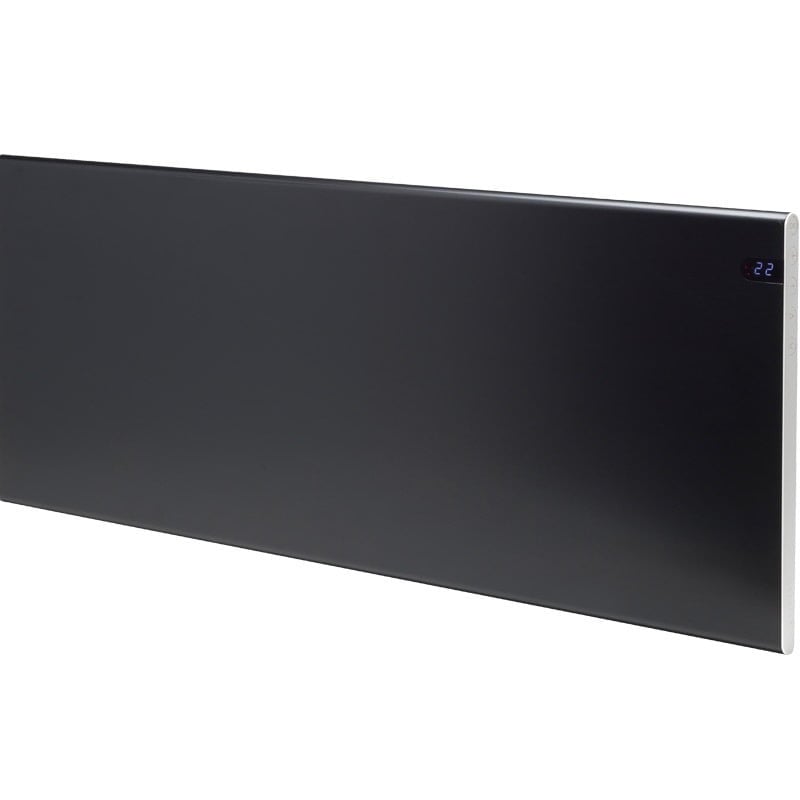
Prefer simpler controls? The ADAX Neo Black panel heater with thermostat and timer is £81.67, its low profile skirting version is the same price for awkward spaces under windows, and the ADAX VP12 with Bluetooth app control is £91.00.
The honest bit about oil filled radiators.
Searching for oil filled radiator running costs? Here is the truth: at the point of use, every resistive electric heater is 100 percent efficient. A 1500W oil filled radiator and a 1500W panel heater consume exactly the same electricity and produce exactly the same heat.
The difference is behaviour, not efficiency. An oil filled radiator heats a thermal reservoir of oil first, so it is slower to warm the room, then holds residual warmth after switching off. A panel or convector heater responds within minutes, which pairs better with tight timer schedules because you are not paying to pre-heat a tank of oil before you feel anything. Neither type is inherently cheaper to run per unit of heat delivered.
We should be plain about what we sell: Adax by Solaire supplies wall mounted panel heaters and electric radiators and infrared panel heaters, not oil filled or fan heaters. If you were considering a 750 watt oil filled heater for a bathroom or small room, a fixed programmable heater such as the Radialight Onsen 750W vertical bathroom heater (£166.65) draws the same 18.75p per hour at full output while adding scheduling, and it is safely wall mounted rather than trailing a lead across the floor. And if it is the heat retention of oil you are after, the ceramic answer is better still: the SolAire EXO Ceramic Core Electric Radiator (£196.20) stores warmth in a ceramic core the way oil filled radiators store it in oil, but with no oil to leak, a longer working life, WiFi control built in, and a unit that is easier to dispose of and kinder to the environment when it finally retires.
Infrared deserves a mention for efficiency hunters. Radiant panels such as the Radialight Kyoto Dual Therm (£165.55) and Aetherea Dual Therm (£217.80) warm people and surfaces directly, so they can feel comfortable at a lower air temperature, which in practice can mean fewer kWh for the same comfort in tall or hard to heat spaces.
Five habits that shrink the numbers.
Set the thermostat, then leave it
Each degree lower saves roughly 6 to 10 percent on heating energy. 19 to 20 degrees suits most living rooms; hallways and bedrooms can sit lower.
Heat rooms, not the house
The biggest advantage of electric panel heating over a boiler is zoning. A SolAire LYNDO WiFi heater (£136.00) in the room you use beats reheating every radiator in the building.
Use the schedule, not the switch
Timed heating that starts 30 minutes before you need the room and stops when you leave it is where the 20 to 30 percent saving comes from. WiFi models like the ADAX NEO WiFi (£130.20) let you adjust the schedule from your phone.
Let open window detection work
Lot 20 heaters pause heating when they sense a sudden temperature drop, so airing a room does not mean paying to heat the street.
Check your tariff
The same heater costs 40 percent more to run at 35p per kWh than at 25p. A cheaper tariff or off-peak scheduling often saves more than swapping hardware.
Running costs, answered.
What is the cheapest electric heater to run?
The one correctly sized for the room and fitted with a thermostat and timer. Wattage sets the ceiling on cost per hour, but controls decide the bill. An 800W heater with a good schedule usually costs less over a winter than a cheap 2000W heater with a simple on-off switch.
Are oil filled radiators cheaper to run than panel heaters?
No. Both are resistive electric heaters, so both convert electricity to heat at 100 percent efficiency. A 1500W oil filled radiator costs 37.5p per hour at full output at 25p per kWh, exactly the same as a 1500W panel heater. Oil filled units warm up more slowly and cool down more slowly; the total heat per pound is identical.
How much does a 2000W heater cost per hour?
At full output and 25p per kWh, 50p per hour, or £4.00 across an 8 hour day. With a thermostat holding a set temperature it will usually average considerably less, because the element switches off once the room is warm.
Is a low wattage heater always cheaper to run?
Only if it can actually reach the target temperature. A 400W heater in a large, poorly insulated room will run constantly, cost 10p for every hour of the day, and still leave the room cold. Match wattage to floor area, around 80W per square metre for a typical room, and let the thermostat limit consumption.
Do fan heaters cost more to run?
Per kWh, no: a 2000W fan heater uses the same electricity as any other 2000W heater. In practice they often cost more because most portable fan heaters lack accurate thermostats and 24 hour timers, so they run at full power for longer than a fixed panel heater would need to.
What is the most economical heater for a bathroom?
A wall mounted, appropriately IP rated heater with a programmable timer, sized to the room. Bathrooms are used in short bursts, so scheduled heating before your morning routine beats leaving anything running. The programmable 750W Radialight Onsen costs at most 18.75p per hour at 25p per kWh. Bathroom electrics must respect IP zone rules and be installed to BS 7671, with notifiable work covered by Part P.
Is delivery free?
Yes. Free next working day delivery applies to mainland UK and Isle of Man orders. Call 01325 717 899 for delivery elsewhere or for help choosing the right wattage for your room.
Ready for heating you can actually budget?
Every panel, convector and infrared heater we sell, with thermostats and timers that keep the running costs honest. Free next working day delivery to mainland UK and Isle of Man.
Shop Electric Heaters and RadiatorsStill weighing it up? Browse the full buying guide library, work out your wattage with What Size Electric Heater Do I Need? or compare controls in Smart Electric Heating Controls: WiFi, Thermostats and Timers.
From our blog: Heating Oil Prices in 2026: Why Smart Homeowners Are Switching to Electric Radiators, How Smart Electric Heating Controls Reduce Running Costs: A Homeowner's Guide and Night Storage Heaters vs Modern Electric Panel Radiators: A 2026 Cost Comparison.