
Night Storage Heaters vs Modern Electric Panel Radiators: A 2026 Cost Comparison
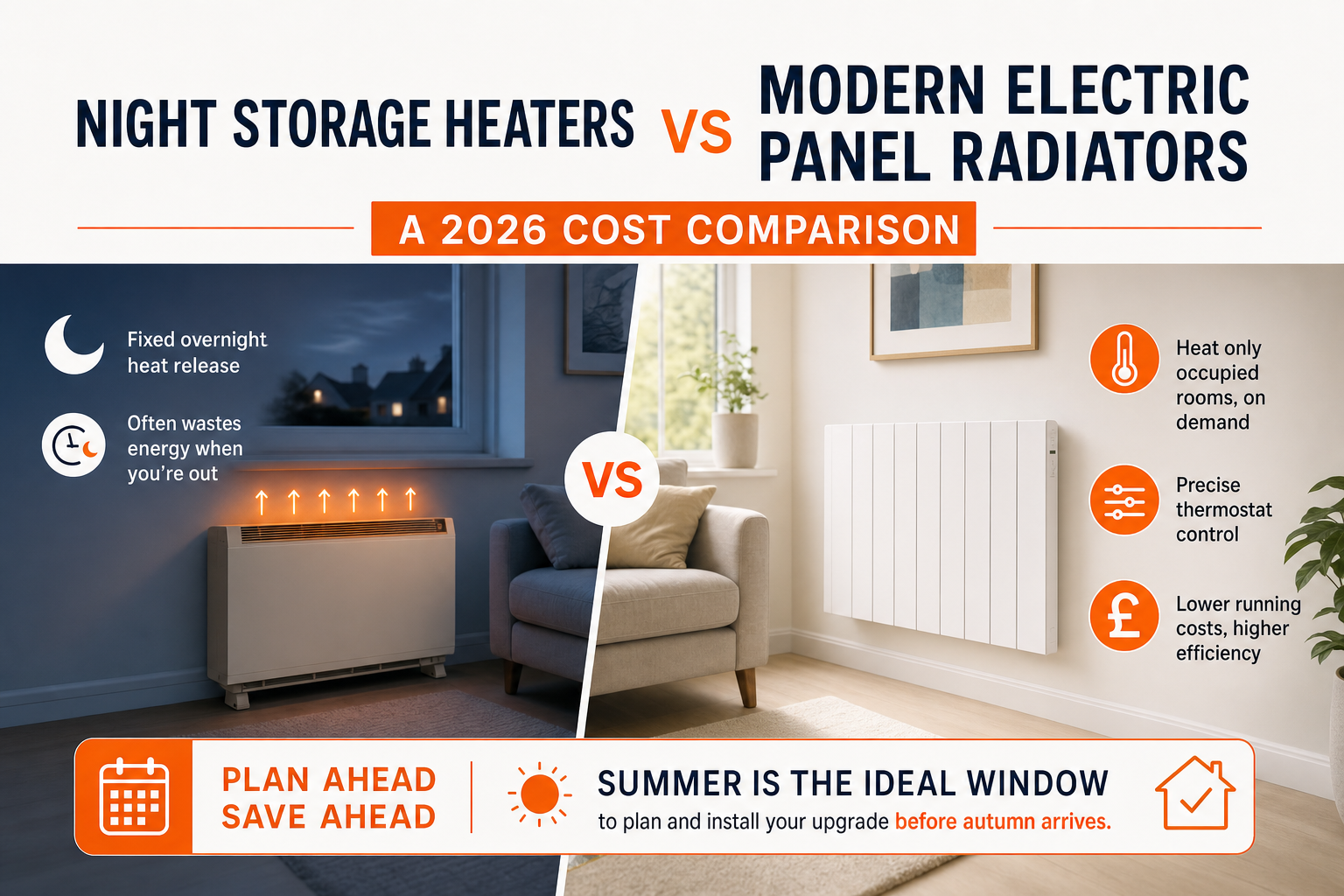
If your home still relies on ageing night storage heaters, you have probably wondered whether a smarter night storage heater alternative could keep you warmer for less. As energy costs and expectations shift in 2026, more UK homeowners are asking exactly that question. The answer, increasingly, points towards modern electric panel radiators.
Key Takeaways
- Storage heaters release heat on a fixed overnight schedule, often wasting warmth when you are out.
- Modern panel radiators heat only occupied rooms, on demand, with precise thermostat control.
- Summer is the ideal window to plan and install an upgrade before autumn arrives.
How Night Storage Heaters Actually Work
Night storage heaters were designed decades ago around cheaper off-peak electricity. They charge overnight on Economy 7 tariffs, storing heat in dense ceramic bricks. Throughout the following day, that stored warmth slowly releases into your room.
The principle made sense when off-peak electricity was far cheaper and homes had few alternatives. A well-charged unit could keep a room reasonably warm without drawing daytime power. For many households in the 1970s and 80s, this was the sensible choice.
The catch is timing. Storage heaters release heat whether you need it or not, so much of the warmth escapes during the morning while you are out. By evening, when you are home and want comfort, the bricks have often cooled.
This mismatch between when heat is produced and when it is wanted sits at the heart of the problem. You pay to store energy you cannot fully use, then top up with expensive daytime electricity to stay comfortable.
Why Homeowners Are Seeking a Night Storage Heater Alternative
A growing number of UK homeowners are actively searching for a night storage heater alternative, and the reasons are rarely just about money. Older units become unreliable, bulky, and difficult to control with any real precision.
Many traditional storage heaters lack meaningful thermostats or timers. You set an input and output dial, then hope the weather cooperates. On a mild day you overheat; during a cold snap you run out of stored warmth by teatime.
There is also the physical footprint. Traditional storage heaters are deep, heavy and visually dated, dominating wall space in rooms where design increasingly matters. Replacing them opens up both the room and your options.
Add tightening efficiency expectations and the erosion of some off-peak advantages, and the case for change strengthens. Homeowners want heating that responds to real life, not a schedule fixed the night before.
The real inefficiency of a storage heater is not the technology itself, but the timing. You are asked to predict tomorrow’s warmth today, and any wrong guess costs you comfort or money.
Modern Electric Panel Radiators Explained
Modern electric panel radiators take a fundamentally different approach. Rather than storing heat in advance, they convert electricity to warmth on demand, exactly when a room is occupied and only for as long as it is needed.
Adax panels use precise digital thermostats, often accurate to within a fraction of a degree. The heater works briefly to reach your set temperature, then idles, sipping small amounts of power to maintain comfort rather than running flat out.
This on-demand model removes the guesswork. There is no overnight charging decision, no wasted morning heat, and no cold evenings caused by a schedule set the night before. You heat the room you are in, when you are in it.
Crucially, every unit of electricity a panel heater draws becomes heat in your room. Both systems are efficient at the meter, but panels waste far less by warming only when it genuinely matters.
The 2026 Cost Comparison: Running Costs Head to Head
On paper, storage heaters look cheap because they draw electricity at off-peak rates. In practice, the comparison is more nuanced, and the gap has narrowed considerably by 2026.
Economy 7 tariffs charge a low overnight rate but a higher daytime rate than a standard single tariff. If you use much daytime electricity for cooking, working from home or topping up heat, those pricier hours can quietly erode the overnight savings.
Panel radiators on a standard tariff avoid that penalty. Because they heat only occupied rooms for short periods, total consumption often falls, even without cheap night-time units. Precise thermostats mean you rarely pay for warmth you do not use.
The honest answer is that costs depend on your home, habits and tariff. But for households out during the day or heating rooms selectively, a modern panel system frequently proves cheaper to run in real conditions.
- Storage heaters: low overnight rate, but heat is fixed in advance and often wasted.
- Panel radiators: heat on demand, so consumption tracks your actual use.
- Best value comes from matching the system to how and when you really occupy each room.
Comfort, Control and Everyday Living
Cost is only half the story. The daily experience of living with each system differs enormously, and this is where modern panels pull decisively ahead.
With programmable panel radiators, you set a weekly programme matched to your routine – warm mornings, cooler empty afternoons, cosy evenings. Many models offer app or smart-home control, so you can adjust heating from your phone or by voice.
Storage heaters offer nothing comparable. Their output is largely decided the previous night, leaving you to open windows when a room overheats or reach for a plug-in heater when it runs cold.
Panels also warm up and cool down quickly, giving genuinely responsive control. Come home early, and a tap on your phone has the room comfortable within minutes rather than tomorrow.
- Room-by-room scheduling that follows your real week.
- Accurate thermostats that hold a steady, comfortable temperature.
- Smart and app control for adjustments on the move.
- Slim, minimal designs that suit modern interiors.
Making the Switch: What to Consider Before Autumn
Summer is the ideal time to plan a heating upgrade. With no immediate demand for warmth, you can install and test a new system calmly before the first cold evenings arrive.
Start by assessing each room. Bedrooms, living spaces and bathrooms have different needs, and choosing correctly sized panels ensures efficient, even warmth. Under-specifying leaves units running constantly; over-specifying simply wastes money.
Installation is refreshingly simple. Adax electric panel heaters mount on the wall and connect to a standard supply, with no pipework, boiler or wet system involved. A qualified electrician can typically replace a storage heater in a single visit.
Consider your bathroom too. Electric towel radiators pair naturally with panel heaters, giving warm towels and a comfortable room while completing a consistent, controllable whole-home electric heating setup.
Final Thoughts
Night storage heaters served their era well, but 2026 offers a smarter path. Modern panel radiators heat only what you use, when you use it, with the control and design that ageing units simply cannot match.
For most households, the deciding factor is not a single headline figure, but the freedom to heat responsively and comfortably. Plan your upgrade this summer, and you will feel the difference the moment autumn returns.
Ready to Retire Your Storage Heaters?
Adax offers Norwegian-designed electric panel heaters with precise control and a clean, minimal finish for every room.