
Bathroom Heating: What Is Safe and What Works
Bathroom heating: what is safe, and what works.
Bathrooms mix water and electricity, so UK wiring regulations divide the room into zones and set rules for what can go where. This guide explains the zones in plain English, then walks through the three bathroom heating options that actually work: heated towel rails, splash proof panel heaters and infrared panels.
IP zones decide what goes where.
BS 7671, the UK wiring regulations, treats a bathroom as a series of zones measured out from the bath or shower. The closer to the water, the tougher the protection an appliance needs. An IP rating tells you how well a heater is sealed against water: the second digit is the one that matters, so IPX4 means protected against splashing from any direction.
| Zone | Where it is | Minimum protection | What that means for heating |
|---|---|---|---|
| Zone 0 | Inside the bath or shower tray itself | IPX7 and SELV (max 12V) | No heaters here, ever. Only low voltage equipment rated for immersion is permitted. |
| Zone 1 | Directly above the bath or shower, up to 2.25m from floor level | IPX4 minimum | Only appliances specifically rated and permitted for zone 1. Most wall mounted heaters do not belong here. |
| Zone 2 | The area extending 0.6m horizontally beyond zone 1, up to 2.25m high | IPX4 minimum | Splash proof heaters and heated towel rails with a suitable IP rating can be installed here. |
| Outside zones | Everywhere else in the room | No specific IP requirement | Most bathroom radiators and panel heaters live here, though a splash resistant rating is still sensible in a steamy room. |
Where water jets are used for cleaning, for example in some wet rooms, the requirement rises to IPX5. Two more rules apply everywhere in the room. First, there are no standard plug sockets in a UK bathroom, so every fixed heater is wired to a fused spur, usually with the switch outside the room. Second, electrical installation work in a bathroom falls under Part P of the Building Regulations, so it must be carried out or certified by a qualified electrician. None of this is difficult or expensive, but it is the reason a plug-in fan heater balanced on the windowsill is never the answer.
Three bathroom heating options that actually work.
Heated towel rail
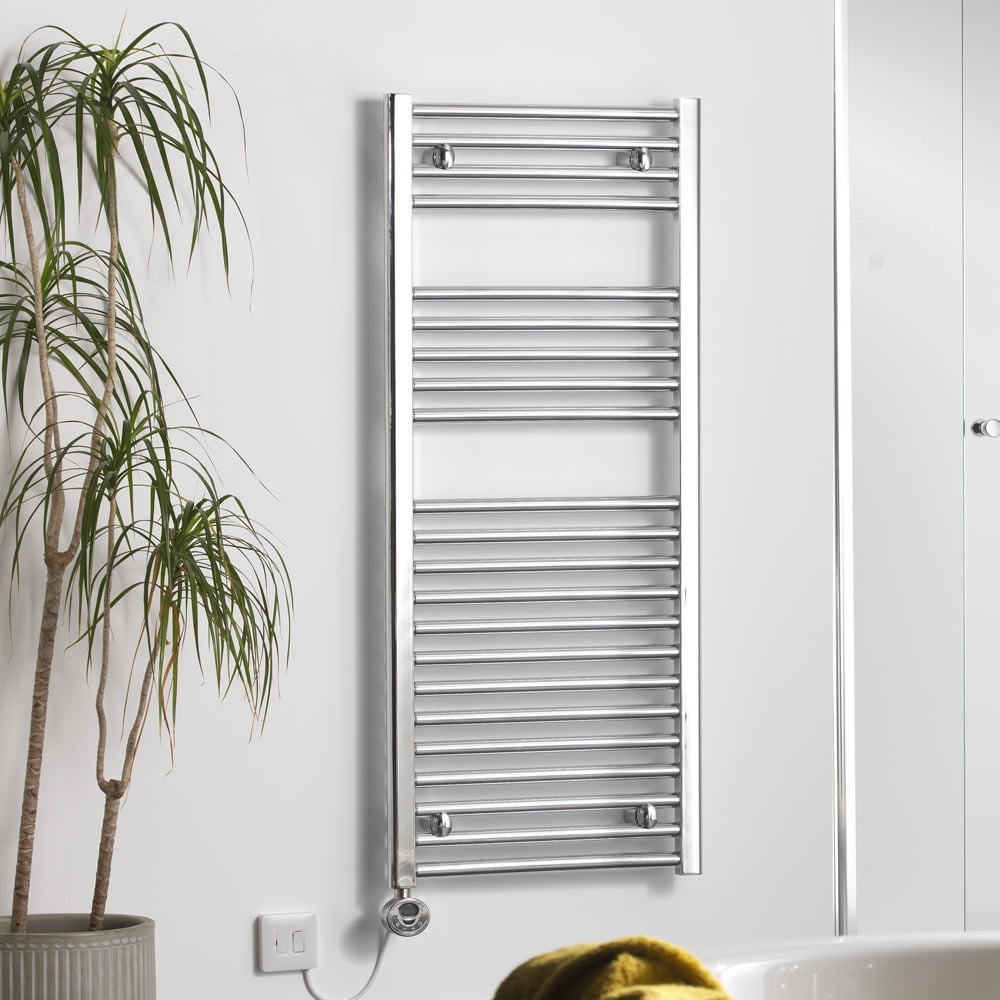
The classic wall mounted bathroom radiator: a ladder of horizontal rails for towels that also provides steady background heat. Slim, flat against the wall and available in chrome, white, black and anthracite, a towel radiator is the default choice for most UK bathrooms. Electric models arrive pre-filled and simply wire to a fused spur, and dual fuel versions run from the boiler in winter and an element in summer. Browse all heated towel rails, the electric heated towel rails, or our Bray range guide.
Splash proof panel heater
When you want the room warm fast, not just the towels, a splash proof electric panel heater is the tool. These are IP rated wall mounted heaters with thermostats and timers, so they heat the bathroom to a set temperature on your schedule. The ADAX Compact WiFi wall mounted radiator (IPX4, currently £121.80 on clearance) and the vertical Radialight Onsen 750W bathroom heater (£166.65) are two good examples. See all splash proof panel heaters and the models with built-in timers.
Infrared panel
An infrared panel heater warms people and surfaces directly rather than the air, which suits bathrooms because the warmth is felt quickly and is not lost when steam is extracted. Our mirrored versions double as an electric bathroom mirror: the 350W mirrored WiFi infrared heater (595 x 595 x 22mm, £242) is a heater and mirror in one panel just 22mm deep, far slimmer than a 40mm bathroom heater. Always check the IP rating against the zone before fitting one in a bathroom.
Sizing a bathroom heater.
Bathrooms are small but demanding: high humidity, frequent air changes from the extractor fan, and a strong preference for being warm at 7am. Three rules cover it.
Start at 80W per square metre
For radiators and towel rails, allow around 80W of output per square metre of floor. A typical 2m x 2.5m family bathroom is 5m², so roughly 400W keeps it comfortable. This is a rule of thumb: poorly insulated rooms, external walls and large windows all push the figure up.
Size up for fast recovery
A bathroom is used in short bursts, and a shower dumps a lot of moisture into the air. A heater with headroom above the minimum reheats the room quickly after the door has been open and helps dry out damp air, so when in doubt choose the next size up. The thermostat prevents oversized heaters wasting energy: they simply reach temperature sooner and cycle off.
Count the towels
If a towel rail is doing double duty as the room’s main radiator, remember that towels draped over it absorb some of its output. For a family bathroom where the rail is the only heat source, size generously or pair a compact rail with a separate panel heater.
What we recommend by bathroom type.
Compact towel rail.
Small rooms need very little heat, so a compact, narrow heated towel rail covers both jobs: warm towels and enough background warmth for a small space. Slim ladder rails sit almost flat to the wall, which matters in a tight en-suite. Chrome suits traditional rooms, while black and anthracite rails work well against light tiles. Start with our space-saving heating for bathrooms and hallways collection.
Tall rail, or rail plus panel.
Larger bathrooms need more output than a small towel warmer provides. Either choose a tall wall mounted towel radiator sized to the 80W per m² rule, or pair a mid-size rail for towels with a controllable splash proof panel heater for the room. The two-heater approach gives fast heat on a timer plus dry towels all year, and is usually the most comfortable setup for a busy household.
Check the zones twice.
In a wet room the shower has no enclosure, so zones 1 and 2 cover far more of the room and IPX5 can apply where water jets are used. Position heaters outside the zones where possible, insist on the right IP rating where not, and have the installation planned by a qualified electrician. If you are unsure which models qualify, call us on 01325 717 899 before you buy.
Bathroom heating, answered.
Can you put an electric heater in a bathroom?
Yes, provided it is a fixed, wall mounted heater with an IP rating suitable for the zone it occupies, wired to a fused spur by a qualified electrician in line with BS 7671 and Part P. Heated towel rails, splash proof panel heaters and suitably rated infrared panels are all designed for exactly this.
What IP rating does a bathroom heater need?
It depends where it is mounted. In zones 1 and 2 the minimum is IPX4, rising to IPX5 where water jets are used for cleaning. Outside the zones there is no specific IP requirement, though splash resistance is still worth having in a steamy room. Zone 0, inside the bath or shower itself, is off limits to heaters entirely.
Can I use a plug-in heater in a bathroom?
No. UK bathrooms have no standard 13A sockets, and portable heaters must not be brought in on an extension lead. Bathroom heaters are permanently wired to a fused spur, normally switched from outside the room, which is safer and tidier.
Do I need an electrician to install a bathroom heater?
Yes. Electrical installation work in a bathroom is covered by Part P of the Building Regulations, so it must be done or certified by a qualified electrician working to BS 7671. Purely electric towel rails and panel heaters involve no plumbing, so it is usually a quick job.
Are heated towel rails enough to heat a bathroom?
Often, yes. Sized at around 80W per square metre of floor, a tall towel radiator will heat a typical small or mid-size bathroom as well as drying towels. In larger family bathrooms, pairing the rail with a splash proof panel heater gives faster warm-up and more control.
Do you sell mirrored bathroom heaters?
Yes. Our mirrored infrared panels work as an electric mirror and a heater in one, in slim 22mm and 12mm deep formats with WiFi and remote control, from the 320W mirrored panel at £189 upwards. Check the IP rating against your zones, or call 01325 717 899 and we will confirm suitability for your room.
Warm, safe, sorted.
Compact towel rails, splash proof panel heaters and slim infrared panels chosen for small, steamy rooms, with free next working day delivery to mainland UK and the Isle of Man.
Shop Bathroom HeatingExplore the rest of our buying guide library, or continue with Curved vs Straight Heated Towel Rails and Electric Heater Running Costs.
From our blog: The Hidden Benefits of Electric Towel Radiators Beyond Winter: Moisture Control & Year-Round Comfort and Why August Is the Perfect Time to Install a Heated Towel Rail.